

VAN WAES Vincent
PU
Directeur INSERM UMR1322 LINC/ Responsable du Master 2 Physiologie, Neurosciences et Comportement/ Membre CNU 69ème section
Academic Background
- Impact of non-invasive brain stimulation on addiction-related behaviors, mood and cognition: preclinical studies (2010-)
University Marie and Louis Pasteur - Targeting tongue fat taste sensors to decrease obesity: impact of fat taste modulators on the reward system (2021-)
University Marie and Louis Pasteur - Regulation of basal ganglia-cortical interactions by psychostimulants (2008-2010)
Chicago Medical School - Impact of prenatal stress on alcohol consumption (2004-2008)
University of Lille 1 / Universita La Sapienza, Roma
Research
- Research topics: Addiction, Depression, Stress, Cognition, Transcranial direct current stimulation (tDCS), Adolescence, Fat taste modulators, Reward system.
- Methods: Animal models, Behavioral analysis, Gene expression profiling, Immunohistochemistry.
Teaching
- Director of the Master’s Program (M2) Physiology, Neuroscience and Behavior
- Teaching in Integrative Neuroscience (Besancon)
Undergraduate and Master’s programs in Life Sciences and Psychology, Medical studies (3rd–6th year) - Master’s programs in Fundamental and Clinical Neurosciences (Lyon) and P2 Food (Dijon).
Collaborations

Links
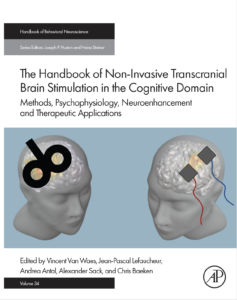
“Predicting brain activity is important for diagnosis. Controlling it is critical for disease. There are only a limited number of ways brain activity can be controlled non-invasively, each with advantages and shortcomings. These critical issues are debated in the didactic chapters of this volume, contributed by top experts in these fields, covering transcranial magnetic and electrical stimulation and ultrasound stimulation. The principle of “primum non nocere” (first, do no harm) is discussed by several authors, emphasizing the need to learn more about the mechanisms of these methods. The reader will walk away with the important message that non-invasive perturbation, especially its closed-loop (on-demand) version, is on its way to effectively compete with pharmaceuticals with much fewer side effects.” György Buzsáki, MD, PhD. BRAIN PRIZE 2011
This volume brings together the work of 31 leading international research teams investigating non-invasive transcranial brain stimulation to advance our understanding of brain function and to develop innovative treatments for psychiatric and neurological disorders. It adopts a multidisciplinary perspective, integrating fundamental research, clinical studies, computational modeling, and ethical considerations.