

Notre laboratoire vient de publier un livre en collaboration avec 4 équipes européennes :
Édité par Vincent Van Waes, Jean-Pascal Lefaucheur, Andrea Antal, Alexander T. Sack, et Chris Baeken
Ce livre rassemble les travaux de 31 équipes internationales travaillant sur les stimulations transcrâniennes afin de mieux comprendre le fonctionnement du cerveau et de traiter les troubles psychiatriques et neurologiques. Il aborde ces thématiques selon des approches complémentaires : recherche fondamentale, recherche clinique, modélisation computationnelle et réflexion éthique.
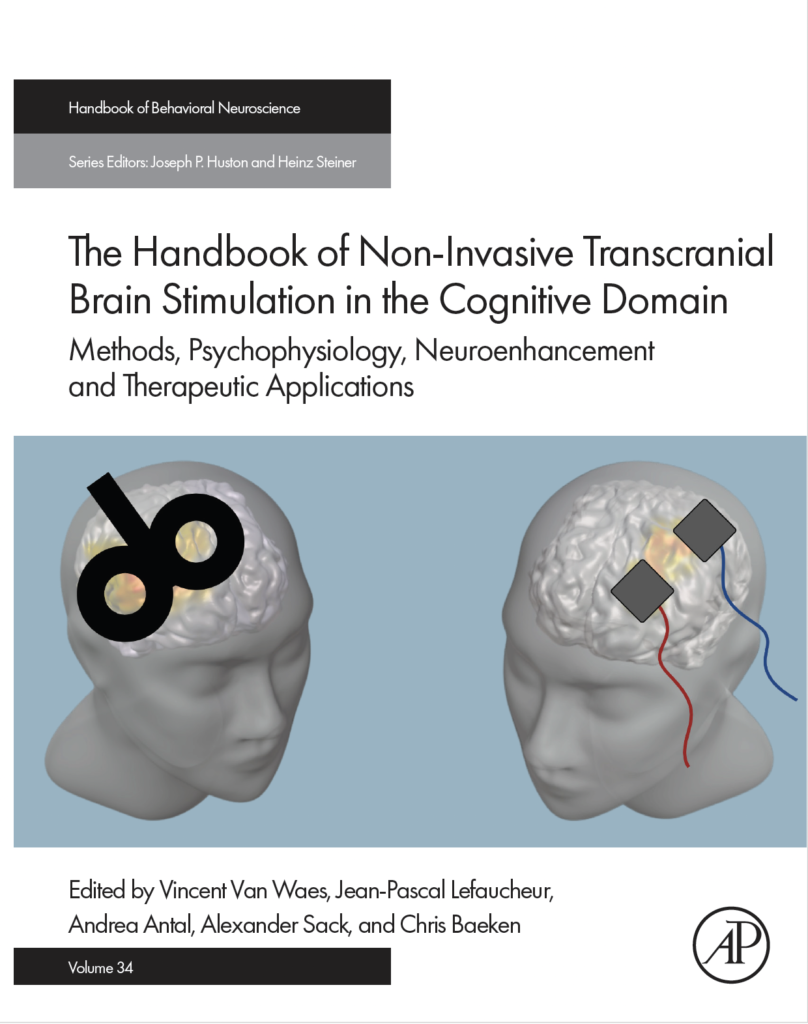
The Handbook of Non-Invasive Transcranial Brain Stimulation in the Cognitive Domain: Methods, Psychophysiology, Neuroenhancement and Therapeutic Applications
Edited by Vincent Van Waes, Jean-Pascal Lefaucheur, Andrea Antal, Alexander T. Sack, and Chris Baeken
The Handbook of Non-Invasive Transcranial Brain Stimulation in the Cognitive Domain: Methods, Psychophysiology, Neuroenhancement and Therapeutic Applications presents the latest scientific insights and technological advancements in the field of noninvasive transcranial brain stimulation (NIBS) within the cognitive domain. This comprehensive volume reviews published research and explores future directions for the use of NIBS techniques, in particular repetitive transcranial magnetic stimulation (rTMS) and low-intensity transcranial electrical stimulation (tDCS, tACS), to study and modulate human cognition as well as to treat various psychiatric and neurological disorders from a neurocognitive perspective. By integrating findings from preclinical animal studies, modeling approaches, and research, this book sheds light on the neurobiological mechanisms underlying cognitive processes and neuroplasticity. It provides a detailed analysis of how NIBS affects psychophysiology and cognitive performance in healthy populations while offering insights into its therapeutic potential for patients with cognitive impairments across a wide range of neuropsychiatric disorders.
This handbook offers an unparalleled gateway to the dynamic and rapidly advancing field of neuromodulation and serves as an essential resource for researchers, clinicians, students, and policymakers.
Key Features:
- Delivers an in-depth exploration of neuromodulation techniques, their applications in cognitive brain research, and therapeutic potential for diverse neuropsychiatric disorders.
- Combines evidence from preclinical studies, computational models, and clinical research to illuminate the neurobiological mechanisms of NIBS on cognition and neuroplasticity.
- Highlights the latest advancements in noninvasive brain stimulation techniques, showcasing their future potential beyond the current state of the art
Préface/Foreword : Simone Rossi
Blurp : György Buzsáki
BLURP György Buzsáki, Brain Prize 2011 :
Predicting brain activity is important for diagnosis. Controlling it is critical for disease. There are only a limited number of ways brain activity can be controlled non-invasively, each with advantages and shortcomings. These critical issues are debated in the didactic chapters of this volume, contributed by top experts in these fields, covering transcranial magnetic and electrical stimulation and ultrasound stimulation. The principle of “primum non nocere” (first, do no harm) is discussed by several authors, emphasizing the need to learn more about the mechanisms of these methods. The reader will walk away with the important message that non-invasive perturbation, especially its closed-loop (on-demand) version, is on its way to effectively compete with pharmaceuticals with much fewer side effects.
–György Buzsáki, MD, PhD. Author of the Rhythms of the Brain (OUP, 2006). BRAIN PRIZE 2011